

Time-Frequency Analysis of Electroencephalograph (EEG) for Feature Optimization
Time-Frequency Analysis of Electroencephalograph (EEG) for Feature Optimization
Document from the year 2017 in the subject Medicine - Biomedical Engineering, grade: 3.0, language: English, abstract: Electroencephalograph (EEG) has been widely used for BCI applications due to its non-invasiveness,...
Regular price
$92.90
Sale price
$92.90
Regular price
$97.90
Unit price
per
Vendor
Grin Verlag173 In stock
Sub total
$92.90Couldn't load pickup availability
Estimated deliver 5-7 days
People are viewing this right now
Description
Shipping Information
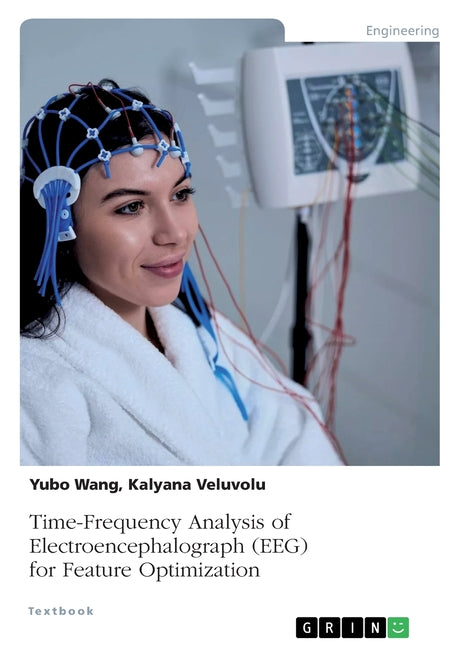
Document from the year 2017 in the subject Medicine - Biomedical Engineering, grade: 3.0, language: English, abstract: Electroencephalograph (EEG) has been widely used for BCI applications due to its non-invasiveness, ease of implementation, and cost-efficiency. The collected EEG signal is non-stationary and has task-related information buried in the frequency and temporal domains. In this book, we focused on developing time-frequency decomposition methods for improving the feature extraction module in BCI systems. The obtained features are then optimized by identifying subject-specific reactive band and employing evolutionary algorithm-based methods for optimizing the obtained features, improving the BCI systems' performance. A signal model named as band-limited multiple Fourier linear combiner (BMFLC) is employed to model the non-stationarity in the EEG signal for feature extraction. The non-stationary amplitude oscillation is presented as adaptive weights in the model and estimated with various adaptive filters such as least-mean square (LMS), Kalman filter (KF), or Kalman Smoother (KS). The estimated coefficients serve as features for classification. Our results suggest that the BMFLC-LMS, BMFLC-KF, and BMFLC-KS are all sufficient in modeling EEG signal in the band with average estimation accuracies of 93%, 99%, and 98%, respectively. We modelled motion-induced EEG signal in frequency domain. We found that most subjects present a subject- specific reactive band during motion tasks. We then constructed features for a classifier that used only the frequency information in the subject-specific reactive band. As a result, the classification accuracy of the BCI system is improved compared to the system which uses the complete band information. Features obtained from multiple EEG channels need to be optimized to enhance the performance of the BCI systems. Essentially, two problems need to be resolved: 1) volume conduction; 2) dimensionality. The volume conduction
Bahamas (Domestic): Standard delivery available for $10.00 or Free on eligible orders.
International: Flat rate of $20.00
United States:
Economy Mail starts at $4.06.
Expedited Mail from $16.00 (0–5 lb) and $22.50 (5.1–10 lb).
Shipping costs are calculated at checkout based on your location and order weight.